The impacts of global climate change on agricultural systems have become amongst the most significant challenges that we face as a species. Increasingly, global climate change is exerting additional pressures on food production, rural economic well-being, and natural resource availability. The present study has expanded and refined academic literature on how climate change has affected the global crop production system from 2021-2025. The goal of this research is to develop a credible, evidence-based assessment of how modern adaptation mechanisms can improve food security, promote sustainable economic growth, and protect the environment when climate change occurs. In this study, four adaptation pathways were explored as being interlinked with one another: (1) improvement of water resource management and irrigation practices; (2) breeding, production, and dissemination of climate resilient crop varieties; (3) use of digital and precision agriculture technologies; and (4) development of institutional and social capacity of farms. Additionally, by merging 4 of the above strategies, there is potential to improve crop growth due to drought and heat stress by 20-30% and reduce water and energy usage by 50% or beyond. A key finding from our study demonstrates that climate adaptation for agriculture must be viewed as a system-transforming approach, not just a set of technical solutions for agricultural drought and heat stress adaptation. It must also address ecosystem integrity, rural economy stability, and global food system resilience. This study adds to the developing literature regarding climate-smart agriculture through global and regional perspectives, especially focusing on Central Asia and Uzbekistan.
This is an Open Access article, distributed under the terms of the Creative Commons Attribution 4.0 International License (http://creativecommons.org/licenses/by/4.0/), which permits unrestricted use, distribution and reproduction in any medium or format, provided the original work is properly cited.
Climate Change Adaptation, Agricultural Resilience, Water Management, Climate-Smart Agriculture, Digital Farming,
Food Security
1. Introduction
1.1. Background and Problem Statement
Climate change's impact on global farming systems will only become significantly stronger in the next 10 years and especially between 2021 and 2025 as global average temperatures increase, as the occurrence of extreme weather events begins to happen with increasing frequency, and as the variability of global precipitation patterns increases dramatically
[2]
Baker, J., and Smith, T. (2024). The economics of climate adaptation: Global trends 2021–2024. Oxford University Press.
, the frequency of long-term droughts, extreme heat waves, and unanticipated frost occurrences has risen to unprecedented levels. The result has been a corresponding decrease in the stability of crop yields, which creates an increased level of risk in both developed and developing regions.
Agriculture still continues to represent one of the most climate sensitive sectors of the global economy
[5]
Food and Agriculture Organization of the United Nations. (2024). The state of food and agriculture 2024: Climate change and adaptation.
. Any change, even in temperature or rainfall quantity/quality, at the lowest extremes will cause disproportionate losses of crop production capability, especially in arid and semi-arid regions. While the ever-rising population size and the change in food habits increasingly raise the total demand for food, the vulnerability of the food sector to climatic change, issues of food security, and the socio-economic conditions of the regions are vastly poised for serious threats.
1.2. Regional Context: Central Asia and Uzbekistan
According to the World Bank report 2025, climate change has led to an intensification of climate change impacts on Central Asia, such as water scarcity, land degradation, and developing the agricultural landscape in Uzbekistan
[1]
A’zamov, S. R. (2025). Climate resilience in Uzbekistan’s agriculture: 2021–2024 outcomes. Fan Publishing House.
. Glacial melting further complicating the issue of water scarcity for the agricultural sector due to inefficient water use coupled with greater temperature increases on agricultural producers
[8]
Ismoilov, A. M., and Karimov, N. T. (2025). Water–food–energy nexus in Central Asia: 2021–2025 analysis. Journal of Arid Environments, 12(1).
. In this environment, farmers need to adapt to their environments to survive; adaptation is no longer optional but required, as emphasized in recent international climate adaptation policy frameworks
[4]
European Commission. (2025). Adaptation to climate change: 2024 progress report.
The transition of the current agricultural system of Uzbekistan into a climate-resilient agricultural system would require many constituent elements of technologically or ecologically driven agricultural development, such as the application of new technologies, innovations, ecological management, and climate-resilient leaders, if favorable results are desired in the coming future (Ismoilov and Karimov, Results of structural assessment of the clinical and hygienic condition of periodontal tissues in patients with anatomical and functional disorders of the mucogingival complex). Failure to apply the best approaches for adapting to climate change
[4]
European Commission. (2025). Adaptation to climate change: 2024 progress report.
, for example, through the application of climate-resilient agricultural practices, would result in the potential cumulative risk of agricultural losses of up to $150 billion in 2025 (The Statistical Yearbook 2024) for the globe, with the highest risk posed by the region that faces water scarcity challenges
[14]
Pimentel, D. (2024). Economic impact of climate change on food systems. In Encyclopedia of food systems. Elsevier.
As a consequence of the complexity of interactions between agricultural production systems, climate dynamics and socio-economic outcomes this study employs a mixed-methods approach to capture all of the interactions between these systems and the impact that they have on each other. The methodology uses a mixed-methods framework that combines experimental field data, laboratory-based assessments of physiological performance and economic assessment through quantitative statistical analysis
[3]
Döring, T. F. (2024). Crop resilience to extreme weather events (2021–2024). Journal of Agronomy, 162(2).
. This integrated design provides a holistic approach within an overall climate adaptation research program by allowing for a simultaneous assessment of biophysical, economic and resource efficiency parameters associated with crop production
[5]
Food and Agriculture Organization of the United Nations. (2024). The state of food and agriculture 2024: Climate change and adaptation.
The research undertaken during the years 2021-2025 utilized several primary and secondary sources. Data for the primary sources came from three geographical areas in Uzbekistan - the Bukhara Region, Fergana Region, and Tashkent Region. Collectively, these three regions represent the arid, semi-arid and relatively high-water availability zones within Uzbekistan's environment. The choice of these regions enables us to study areas with different climatic stress levels, as well as the different practices for irrigation and how they affect crop production in different regions.
Secondary sources included official reports, datasets and statistics from various organisations, including FAO, IPCC, WB and National Government Statistical Agencies. A systematic literature review of peer-reviewed research articles published from 2021 to 2025 was conducted in order to compare and contrast the information obtained on the regions studied with information reviewed on the international context over the same period.
2.3. Agronomic and Climatic Analysis
The climatic factors that this study addresses are average and high temperature, occurrence of heat waves, amount of precipitation, and availability of irrigation water
[9]
Jones, M., et al. (2023). Heatwave impact on global cereal yields (2021–2023). Nature Food, 4, 345–358.
. These factors have been correlated with yield data from some of the world's most important staple foods and cash crops like wheat, cotton, and corn, respectively. The time-series analysis procedures were applied to assess how climate affects the value of the various crops produced
[3]
Döring, T. F. (2024). Crop resilience to extreme weather events (2021–2024). Journal of Agronomy, 162(2).
At the field level the assessment of agricultural productivity assesses how traditional irrigation techniques compare to newer water efficient technologies, such as drip and sprinkler irrigation, using indicators scored for water efficiency (kilograms of yield produced per cubic meter of water consumed)
[11]
Lehmann, J. (2024). Carbon sequestration and soil health in adaptation. Routledge.
. The data was taken over a period of years in order to account for multiple years of climate variations experienced during production of the various crop types.
2.4. Laboratory Experiments and Crop Physiology
Assessing how crops adapt at the individual variety level required performing laboratory tests on the physiological and biochemical characteristics of conventional and resilient varieties using methods described in 2025 by Sultanov. Testing occurred in an environment where heat stress was prevalent (40°C was the highest temperature)
[19]
Sultanov, T. M. (2025). Breeding for heat tolerance in Uzbekistan (2021–2025). Bulletin of Agronomy, 8(3).
, and it provided a means of evaluating the ability of various crop varieties to produce crops under extreme temperatures.
Economic performance was evaluated using several performance indicators including benefit/cost ratios (BCR), net profit/loss after expenses on production (NP), water efficiency, and returns on investment (ROI). The costs associated with these 4 aspects of performance were made up of initial capital costs to establish a system of irrigated agriculture with modern agricultural equipment and inputs (including improved seeds), while benefits were determined from higher levels of productivity than would otherwise occur, increased safety nets for farmers through decreased variability, and enhanced income stability
[7]
Hasanov, B. A. (2024). Biological responses to thermal stress in crops. National University of Uzbekistan.
Descriptive statistical techniques, as well as comparative techniques, synthesized results obtained from multiple geographical regions and various climate adaptation strategies. The triangulation of the data increased the reliability (validity) and robustness of the findings
[25]
Zhu, X., et al. (2023). Global adaptation strategies for cereal crops. Science of the Total Environment.
This study provides strong empirical evidence that agricultural adaptation activities carried out between 2021 and 2025 significantly enhanced both farm yield, resource use efficiency, and economic viability during climate stress conditions (from climatic factors). Climatic data analysed during this study have demonstrated that temperature extremes and frequency of drought have increased leading to instability in crop yield production, particularly in areas with high dependence on traditional agriculture practices
[6]
Ghazaryan, G., and Dubovyk, O. (2023). Satellite-based monitoring for climate-smart farming. Remote Sensing, 15(4).
Water-saving irrigation technologies were identified as one of the most effective agricultural adaptation techniques. The area of Uzbekistan irrigated with modern irrigation systems increased from 433,000 hectares in 201, to over 1.2 million hectares by 2024. Drip and sprinkle irrigation systems used approximately 50 to 55 percent less water than traditional surface irrigation systems. Water saved on an average per hectare, ranged from 3,500 to 4,000 cubic metres of water, with average yield increases as high as 29 percent for cotton, and as high as 15 to 20 percent for cereals. Soil water-holding capability and decreases in secondary soil salt concentration were also enhanced.
Thanks to climate-resilient crop strains, farmers are able to grow crops even when subjected to extreme heating conditions. During the 2021 summer season, crop losses of more than 50% were experienced by traditional maize strains because of extreme heating conditions. However, maize strains that are adapted to these extreme heating conditions were able to maintain their 90%-92% level of yields during the same season. The increasing number of farmers using climate-resilient seeds in 2025 is likely to reduce crop losses experienced because of climate conditions and increase yields across different agro-ecosystems
[10]
Kim, Y., and Lee, H. (2025). Smart farming as an adaptation tool: A five-year study. Sustainable Agriculture Reviews, 58, 211–235.
Through the utilization of digital agriculture & precision agriculture technologies, the efficiency of agricultural inputs has increased significantly, consistent with recent ISDA adaptation data
[21]
United States Department of Agriculture. (2025). Climate change and agricultural adaptation data: 2021–2024.
. The application of precision agriculture management systems from 2022-2024 resulted in a 22% decrease in the use of Fertilizers applied to cropland and an 18% decrease in the amount of electricity consumed while crops were being grown. The use of Satellite-based Soil Moisture and Climate Prediction to provide Early Warnings to Farmers regarding Early Warnings (i.e., Stress) on their Crops decreases the Risk of Crop Loss from Climate Change
[21]
United States Department of Agriculture. (2025). Climate change and agricultural adaptation data: 2021–2024.
In a Financial Analysis of Climate Adaptation Investments, it was determined that the Returns on Adaptation Investments is Significantly High. Within Uzbekistan, for every $1 spent on Climate Adaptation, Farmers realized $3.20 in Returns, whereas, Globally, the Average Return was approximately $4.10. Over the next 5 years, Farm Net Income averaged an increase of nearly 24% due to Higher Productivity and Lower Production Costs.
4. Discussion
The research shows that a successful method to deal with the impacts of climate change on agriculture is using a comprehensive and systematic method of combining water-efficient agricultural irrigation systems with climate-resilient crop varieties through the adoption of digital agriculture technologies. When used together, these three factors yield much higher short-term and long-term results than do any of them used independently of each other
[17]
Reganold, J. P., and Wachter, J. M. (2023). Organic systems and climate resilience. Nature Plants, 9(1).
The way that farmers manage their water supplies will probably be one of the main adaptation focuses for agricultural areas located in arid and semi-arid climatic conditions. The reduction in the amount of water used for agriculture, when studied along with the climate data for the region that indicates a significant reduction in the amount of water resources from the glaciers as a result of the rise in temperature and the reduction in the amount of water runoff from the glaciers, suggests that the implementation of modern irrigation systems will not only be essential for the maintenance of agriculture, but it will also be essential for the maintenance of water resources in the region
[13]
Muller, A., and Schader, C. (2023). Climate change mitigation and adaptation projections. Nature Sustainability, 6(3).
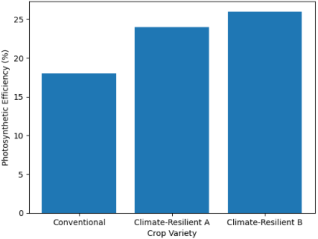
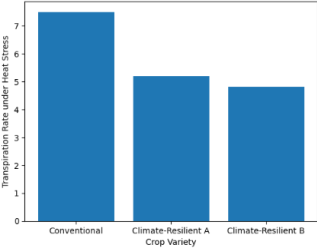
The superior performance of the climate-resilient crop varieties is a clear indication of the importance of continuing to invest in research and development to breed crops. The development of physiological traits such as increased photosynthesis efficiency (Figure 1) and reduced transpiration during heat stress (Figure 2) will have a significant impact on the maintenance of crop yields during climatic upsurges. This is consistent with previous research that has concluded that genetic adaptation is one of the key components of Climate Smart Agriculture (CSA).
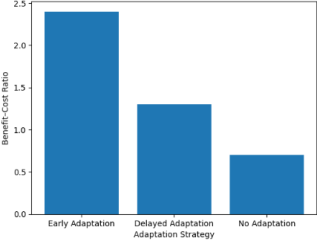
The economic perspective supports the importance of adapting to climate change investments through their respective ratios (Figure 3). These benefit-cost ratios indicate the strategic nature of adaptation investments; investing too late may have disastrous Macroeconomic consequences of potentially losing around 3% of GDP.
The data indicates additional important institutional and social limitations. Limited climate literacy among farmers and a lack of access to extension services are hindering farmers’ adaptation to climate change. Less than a third of farmers rely on climate forecasts in making agricultural decisions; this shows a need for education and promotion through advice
[18]
Sanders, J. (2025). Policy frameworks for climate-smart farming: 2021–2024. Springer Nature.
It can be concluded that for a successful adaptation to climate change, there is a need for more than just innovative adaptation technologies. There is a need for a favorable environment created by the formulation of policies to support adaptation, collaboration between institutions that can help farmers adapt to climate change, as well as a trained workforce that will enable farmers to use innovation in adaptation to climate change.
This graph shows the comparison of photosynthetic efficiency (%) of conventional and climate-resilient crop varieties, thereby establishing the superior carbon assimilation ability of climate-resilient crop varieties. This is a factor that leads to higher yield stability in climate-stressed conditions.
Figure 2. Transpiration rates of crop varieties under heat stress conditions.
This graph shows the differences in transpiration rates under heat stress conditions for conventional and climate-resilient crop varieties. The lower transpiration rate in climate-resilient crop varieties indicates their superior water use efficiency and heat stress tolerance.
Figure 3. Benefit–cost ratios of climate change adaptation investment strategies.
This graph shows the benefit-cost ratios for early adaptation, delayed adaptation, and no adaptation strategies. The findings indicate the macroeconomic benefit of early climate adaptation investment and the possible macroeconomic risks of delayed adaptation investment.
5. Conclusion
The research provides evidence of how the utilization of the adaptability strategies developed during 2021 to 2025 will result in a significant improvement in Agricultural Sector Productivity, Efficiency of Natural Resources and Economic viability of Agriculture in response to the effects of Climate Change due to Global Warming
[5]
Food and Agriculture Organization of the United Nations. (2024). The state of food and agriculture 2024: Climate change and adaptation.
. It also shows that Climate Smart Agriculture can improve yield by 20 - 30% and reduce water and energy consumption by as much as 50%. The research resulted in three main findings: (1) a reliance on modern water management technologies will have to be increased in order for Agricultural production to continue in the future due to the growing scarcity of fresh water; (2) the use of crops that are bred for resistance to climate change will lower the risk of crop failure due to extreme heat or drought, thus contributing to improved Food Security for people around the world.
Next, farmers will improve their risk management, streamline input-use, and enhance decision-making capabilities at the farm level by adopting digital/precise agriculture systems. Support from institutional sources, education of farmers, and extension service providers are critical in helping farmers maximize the benefits available under these adaptation strategies. Not only will increasing environmentally-friendly agricultural production systems help to protect the planet, but by implementing an integrated method that prioritizes the development of technology and enhancing the ability of farmers to effectively manage their resources, the likelihood for agricultural producers to adapt to changing climatic patterns and enjoy long-term success will improve significantly through increased resilience and sustainability
[16]
Rahmonov, O. (2024). Green investment and adaptation in agriculture. Iqtisod-Moliya Publishing.
Bakhodirovich, R. A. (2026). Integrated Climate Adaptation Strategies for Sustainable Agricultural Growth and Food Security. American Journal of Operations Management and Information Systems, 11(2), 33-38. https://doi.org/10.11648/j.ajomis.20261102.11
Bakhodirovich, R. A. Integrated Climate Adaptation Strategies for Sustainable Agricultural Growth and Food Security. Am. J. Oper. Manag. Inf. Syst.2026, 11(2), 33-38. doi: 10.11648/j.ajomis.20261102.11
@article{10.11648/j.ajomis.20261102.11,
  author = {Ravshan Asamov Bakhodirovich},
  title = {Integrated Climate Adaptation Strategies for Sustainable Agricultural Growth and Food Security},
  journal = {American Journal of Operations Management and Information Systems},
  volume = {11},
  number = {2},
  pages = {33-38},
  doi = {10.11648/j.ajomis.20261102.11},
  url = {https://doi.org/10.11648/j.ajomis.20261102.11},
  eprint = {https://article.sciencepublishinggroup.com/pdf/10.11648.j.ajomis.20261102.11},
  abstract = {The impacts of global climate change on agricultural systems have become amongst the most significant challenges that we face as a species. Increasingly, global climate change is exerting additional pressures on food production, rural economic well-being, and natural resource availability. The present study has expanded and refined academic literature on how climate change has affected the global crop production system from 2021-2025. The goal of this research is to develop a credible, evidence-based assessment of how modern adaptation mechanisms can improve food security, promote sustainable economic growth, and protect the environment when climate change occurs. In this study, four adaptation pathways were explored as being interlinked with one another: (1) improvement of water resource management and irrigation practices; (2) breeding, production, and dissemination of climate resilient crop varieties; (3) use of digital and precision agriculture technologies; and (4) development of institutional and social capacity of farms. Additionally, by merging 4 of the above strategies, there is potential to improve crop growth due to drought and heat stress by 20-30% and reduce water and energy usage by 50% or beyond. A key finding from our study demonstrates that climate adaptation for agriculture must be viewed as a system-transforming approach, not just a set of technical solutions for agricultural drought and heat stress adaptation. It must also address ecosystem integrity, rural economy stability, and global food system resilience. This study adds to the developing literature regarding climate-smart agriculture through global and regional perspectives, especially focusing on Central Asia and Uzbekistan.},
 year = {2026}
}
TY  - JOUR
T1  - Integrated Climate Adaptation Strategies for Sustainable Agricultural Growth and Food Security
AU  - Ravshan Asamov Bakhodirovich
Y1  - 2026/07/22
PY  - 2026
N1  - https://doi.org/10.11648/j.ajomis.20261102.11
DO  - 10.11648/j.ajomis.20261102.11
T2  - American Journal of Operations Management and Information Systems
JF  - American Journal of Operations Management and Information Systems
JO  - American Journal of Operations Management and Information Systems
SP  - 33
EP  - 38
PB  - Science Publishing Group
SN  - 2578-8310
UR  - https://doi.org/10.11648/j.ajomis.20261102.11
AB  - The impacts of global climate change on agricultural systems have become amongst the most significant challenges that we face as a species. Increasingly, global climate change is exerting additional pressures on food production, rural economic well-being, and natural resource availability. The present study has expanded and refined academic literature on how climate change has affected the global crop production system from 2021-2025. The goal of this research is to develop a credible, evidence-based assessment of how modern adaptation mechanisms can improve food security, promote sustainable economic growth, and protect the environment when climate change occurs. In this study, four adaptation pathways were explored as being interlinked with one another: (1) improvement of water resource management and irrigation practices; (2) breeding, production, and dissemination of climate resilient crop varieties; (3) use of digital and precision agriculture technologies; and (4) development of institutional and social capacity of farms. Additionally, by merging 4 of the above strategies, there is potential to improve crop growth due to drought and heat stress by 20-30% and reduce water and energy usage by 50% or beyond. A key finding from our study demonstrates that climate adaptation for agriculture must be viewed as a system-transforming approach, not just a set of technical solutions for agricultural drought and heat stress adaptation. It must also address ecosystem integrity, rural economy stability, and global food system resilience. This study adds to the developing literature regarding climate-smart agriculture through global and regional perspectives, especially focusing on Central Asia and Uzbekistan.
VL  - 11
IS  - 2
ER  -
Department of Economics, International Agriculture University, Tashkent, Uzbekistan; Department of Agribusiness Management and Logistics, Tashkent State Agrarian University, Tashkent, Uzbekistan
Bakhodirovich, R. A. (2026). Integrated Climate Adaptation Strategies for Sustainable Agricultural Growth and Food Security. American Journal of Operations Management and Information Systems, 11(2), 33-38. https://doi.org/10.11648/j.ajomis.20261102.11
Bakhodirovich, R. A. Integrated Climate Adaptation Strategies for Sustainable Agricultural Growth and Food Security. Am. J. Oper. Manag. Inf. Syst.2026, 11(2), 33-38. doi: 10.11648/j.ajomis.20261102.11
@article{10.11648/j.ajomis.20261102.11,
  author = {Ravshan Asamov Bakhodirovich},
  title = {Integrated Climate Adaptation Strategies for Sustainable Agricultural Growth and Food Security},
  journal = {American Journal of Operations Management and Information Systems},
  volume = {11},
  number = {2},
  pages = {33-38},
  doi = {10.11648/j.ajomis.20261102.11},
  url = {https://doi.org/10.11648/j.ajomis.20261102.11},
  eprint = {https://article.sciencepublishinggroup.com/pdf/10.11648.j.ajomis.20261102.11},
  abstract = {The impacts of global climate change on agricultural systems have become amongst the most significant challenges that we face as a species. Increasingly, global climate change is exerting additional pressures on food production, rural economic well-being, and natural resource availability. The present study has expanded and refined academic literature on how climate change has affected the global crop production system from 2021-2025. The goal of this research is to develop a credible, evidence-based assessment of how modern adaptation mechanisms can improve food security, promote sustainable economic growth, and protect the environment when climate change occurs. In this study, four adaptation pathways were explored as being interlinked with one another: (1) improvement of water resource management and irrigation practices; (2) breeding, production, and dissemination of climate resilient crop varieties; (3) use of digital and precision agriculture technologies; and (4) development of institutional and social capacity of farms. Additionally, by merging 4 of the above strategies, there is potential to improve crop growth due to drought and heat stress by 20-30% and reduce water and energy usage by 50% or beyond. A key finding from our study demonstrates that climate adaptation for agriculture must be viewed as a system-transforming approach, not just a set of technical solutions for agricultural drought and heat stress adaptation. It must also address ecosystem integrity, rural economy stability, and global food system resilience. This study adds to the developing literature regarding climate-smart agriculture through global and regional perspectives, especially focusing on Central Asia and Uzbekistan.},
 year = {2026}
}
TY  - JOUR
T1  - Integrated Climate Adaptation Strategies for Sustainable Agricultural Growth and Food Security
AU  - Ravshan Asamov Bakhodirovich
Y1  - 2026/07/22
PY  - 2026
N1  - https://doi.org/10.11648/j.ajomis.20261102.11
DO  - 10.11648/j.ajomis.20261102.11
T2  - American Journal of Operations Management and Information Systems
JF  - American Journal of Operations Management and Information Systems
JO  - American Journal of Operations Management and Information Systems
SP  - 33
EP  - 38
PB  - Science Publishing Group
SN  - 2578-8310
UR  - https://doi.org/10.11648/j.ajomis.20261102.11
AB  - The impacts of global climate change on agricultural systems have become amongst the most significant challenges that we face as a species. Increasingly, global climate change is exerting additional pressures on food production, rural economic well-being, and natural resource availability. The present study has expanded and refined academic literature on how climate change has affected the global crop production system from 2021-2025. The goal of this research is to develop a credible, evidence-based assessment of how modern adaptation mechanisms can improve food security, promote sustainable economic growth, and protect the environment when climate change occurs. In this study, four adaptation pathways were explored as being interlinked with one another: (1) improvement of water resource management and irrigation practices; (2) breeding, production, and dissemination of climate resilient crop varieties; (3) use of digital and precision agriculture technologies; and (4) development of institutional and social capacity of farms. Additionally, by merging 4 of the above strategies, there is potential to improve crop growth due to drought and heat stress by 20-30% and reduce water and energy usage by 50% or beyond. A key finding from our study demonstrates that climate adaptation for agriculture must be viewed as a system-transforming approach, not just a set of technical solutions for agricultural drought and heat stress adaptation. It must also address ecosystem integrity, rural economy stability, and global food system resilience. This study adds to the developing literature regarding climate-smart agriculture through global and regional perspectives, especially focusing on Central Asia and Uzbekistan.
VL  - 11
IS  - 2
ER  -




 Share This Article
 Twitter
 Linked In
 Facebook
 Copy
Copy Download